In the process of working on a strategic planning exercise for a client, the idea and somehow the need to using something I called "strategic mapping" came up. I then realised - as often - that I had not created something new and that there were already (available) various concept of "strategic mapping". Now I do not feel compelled to forget my initial intentions, and bow to previous thoughts from other consultants. Instead I feel I can learn extra stuff from them while being true and honest to my initial intentions and ideas.
Ludo's initial idea and intention: out of a strategic planning exercise, it seems essential to me to offer an authentic approach to dialog, meaningful dialog, the art and science of conversation. True to that spirit, no strategic thrust can emerge without allowing a meaningful, open, authentic appreciation of what is emerging... various trends, directions, positions, ..... Because it is open, mutli-directional, across section, acros hierarchy and power-structure, a map seems a good way to capture the complexity and the multi-levels of views and perceptions involved... therefore, and quite naturally, a map is to a plan what strategic mapping is to strategic planning.
Now, below some is some introductory info on strategic mapping according to other organisations:.
The information is taken from various websites following a rapid search
taken from http://www.idiagram.com/
What they say: in "The Art of the Strategic Conversation* "
The images we create are tools for catalyzing creative and expansive conversations while keeping those conversations grounded in the reality of the situation.
By literally mapping out the details of your technology, marketplace, strategy, etc. we can give you and your team the opportunity to step back and see better:
see things more clearly
see the big picture
see things together
see things differently
A good strategic map and the process of bringing people together in constructive dialog, can help your team grapple with the complex, various, and difficult issues that are impeding your progress.
Navigating the future without a good map can be difficult and dangerous: difficult to see where you are, and at risk you won't get where you want to go. A good map can help reveal your strategic reality and thus position you to create the future you want. As a tool for generating meaningful conversation and clearer communication, a good map can generateunderstanding and insight, agreement and action.
Another organisation:
taken from http://cdn.information-management.com/
Wednesday, June 23, 2010
Thursday, June 17, 2010
Outdoor education - field of interest to share at the MOE conference
It is time to submit a list of topics for which I will be keen to share and speak at the MOE outdoor education.
Though I never thought of specialising in outdoor education, I have been running hundreds and hundreds of outdoor training programs - many teambuildings and many camps. I created most programs and I had to adapt to many and many various types of situations, people, environment,.... I cannot help but wanting to contribute. I believe one the interesting aspect I am able to contribute is the freshness and innocence directly at the source of our designs. Our delivery is dictated by a strong, imperious need to engage everybody which means: every body should want to play and every body could and would. Last, learning should be a natural outcome - hence the idea of facilitation: (facil is french means easy - to facilitate is to make things easier: to support learning because learning is there, ready to be picked up... like a fruit when it is ripe or when the chick gets out of the shell and the mum gently helps breaking the shell).
"Natural" learning is something I should expand on.... I believe it is something many people do not get - or totally undervalue - and it is not their fault... there is a major drift in our modern societies between our natural abilities to learn and where "modern" education is bringing us, a drift to where and how learning really takes place and where our schools are leading us.
Now outdoor education is just one among the many ways to help us deal with the question of learning but it is a powerful one. Personnally, outdoors have always been an attraction because there is something "wholistic" when it comes to being outdoors. In no any order, I am listing below some of the reasons why I think so:
1- outdoors, the body - not just the mind - is part of the experience: how you walk, run, jump, hang on to something (or not)... etc... it all makes a difference. It matters and cannot be left aside as opposed to purely mind-based form of questioning. How the body gets engaged - in itself - should lead to much discussion. In particular we could start a reflexion on action - engagement - being. A funny - but essential way - to look at it: we all know Rodin's sculpture: "The thinker". Question: is the thinker really thinking? Or is he simply bored? German philosopher Nietzsche was saying (and I got this quote quoted by a famous jazzman - which is in itself significant): "Only thoughts that come as we walk are valuable thoughts (worth considering)"
2- outdoors there is no way but thinking about space and dealing with space and managing space... This is essentials when I see all too often how poorly human beings plan and manage and deal with their own space, their personnal space, their learning space, the private or public space. Learning to acknowledge and deal with space... a capital value.... missed, forgotten, ignored...
Now, what are the implications in terms of OE? There are important and relate in my opinion to a mature audience in the first place: dealing with space is about planning and about developing the ability to see through (helicopter view, mapping things, strategising). To reach to this stage, OE has many steps to cover, starting from the basics: dealing with groups, dynamics of groups, organising camps, to the more advanced: facilitating learning (creating learning space, learning climate, learning tools...).
Here the whole question of learning space can be looked at as the question of dealing with learning ecologies. Each outdoor speciality (outdoor sports and activities) offers a specific learning eco-system, with its idiosyncrasies and its richness. Much education can be derived from there. It needs to be looked into behind the technical aspects, but rather, focusing on what can be more universal and/or relate to behavior, skills and attitude. Of course the technical aspects should be kept and integrated within the bigger picture.
Practically, it could mean looking at building curriculum and lesson plans to train the trainers in the relevant aspects.
3- outdoors and dealing with what is free. The greatest tragedy of our modern world(s) is to have lost touch with the magnificence of what is given and provided to us by Nature and the Creator (in a non-religious sense). Sun, air, water to start with. The very tenets of life are so so taken for granted that we ignore them, we even blame them for most things and we hide and cut ourselves from them. As we do so, the very first thing we should have - gratitude (a with it a sense of love, appreciation, humility, acceptance and the whole gamut of values that build proper attitude, skills and character) - is replaced by a sense of loss, frustration, fear and any opposite to what makes life easy, simple and enjoyable (complexities, negative emotions, ...). Of course, outdoor education in relation to THAT (capita letter because THAT = NATURE = outdoors in this context) teaches about freedom and dealing with freedom as human beings, ie the choice we have to make to find our place in this grand scheme of things and in our lives. OE has a role to play in helping
a- develop a sense of appreciation of nature, leading to respect, care etc...
b- connect the physical reality to the meta-physical reality (our dependancy) and highlight/extract from there the set of values people and society need to adhere to to live live fully, happily, together in peace.(courage, tolerance, patience, determination, collaboration, sharing, listening, and hundreds and hundreds more ....)
In other words, OE has a big role to play in dispensing value-based education
4- As a consequence, outdoors teach us about the essential distinction between NEEDS and WANTS. There is no WANTS in the Nature, there are only needs. Another way to put it is that outdoor education is very strong at reminding us all the time that what we want is only possible to the extent that the circonstance, nature, the weather, the geography allow it.
What about NEEDS AND WANTS is essential for any of us? People, we - are running around crazily talking about what we want to do. Our society has created so many wants so that millions of products can be sold, that we have become consuming machine driven by our wants. That - as early as 1930's how Ford was describing his philosophy of mass-production for mass-marketing. Today, even higher education is using the tricks and selling MBAs to any bored executive in its 30's. As professor, author and educationist Mintzberg puts it in one of his book, let's look for "Managers, not MBAs". It is not about what we have but what we do. We need people with the right values and qualities to run our business and institutions: ideals vs greed, patience vs rushing for quick gain, support of the people vs political backfiring etc....
How do we get OUT of the "wanting" zone? How do we learn about something different? Can we "de-condition" ourselves - after 20, 30, 40 years of exposure to a world bombarded with advertising, malls, commercials, fast food, fast cars, fast relationships, fast jobs... What else do we need to learn? How?
OE puts us in touch with nature and nature has the built-in ability to teach about needs, about reality, real causes and real consequences.... The practical implications are many and very powerful and of great consequences:
a- What does a human being really needs to survive: basics of food, body care and personal hygiene, human inter-personal skills so that I can live peacefully with my peers, intra-personal skills so that I remain a healthy, positive individual?
b- to live, play and enjoy: meanings, purposes of being together in a group or a society, role of rules, punishments, rewards, duties
c- connecting back to our natural learning abilities: what am I good at? what do I really enjoy doing? How do I see myself growing? What is my voice (See the Eigth Discipline by Cowey), my vocation, my destiny?
In Singapore context, any of these issues are highly relevant and can be discussed either in a broad context or in very specific, detailed manner.
Though I never thought of specialising in outdoor education, I have been running hundreds and hundreds of outdoor training programs - many teambuildings and many camps. I created most programs and I had to adapt to many and many various types of situations, people, environment,.... I cannot help but wanting to contribute. I believe one the interesting aspect I am able to contribute is the freshness and innocence directly at the source of our designs. Our delivery is dictated by a strong, imperious need to engage everybody which means: every body should want to play and every body could and would. Last, learning should be a natural outcome - hence the idea of facilitation: (facil is french means easy - to facilitate is to make things easier: to support learning because learning is there, ready to be picked up... like a fruit when it is ripe or when the chick gets out of the shell and the mum gently helps breaking the shell).
"Natural" learning is something I should expand on.... I believe it is something many people do not get - or totally undervalue - and it is not their fault... there is a major drift in our modern societies between our natural abilities to learn and where "modern" education is bringing us, a drift to where and how learning really takes place and where our schools are leading us.
Now outdoor education is just one among the many ways to help us deal with the question of learning but it is a powerful one. Personnally, outdoors have always been an attraction because there is something "wholistic" when it comes to being outdoors. In no any order, I am listing below some of the reasons why I think so:
1- outdoors, the body - not just the mind - is part of the experience: how you walk, run, jump, hang on to something (or not)... etc... it all makes a difference. It matters and cannot be left aside as opposed to purely mind-based form of questioning. How the body gets engaged - in itself - should lead to much discussion. In particular we could start a reflexion on action - engagement - being. A funny - but essential way - to look at it: we all know Rodin's sculpture: "The thinker". Question: is the thinker really thinking? Or is he simply bored? German philosopher Nietzsche was saying (and I got this quote quoted by a famous jazzman - which is in itself significant): "Only thoughts that come as we walk are valuable thoughts (worth considering)"
2- outdoors there is no way but thinking about space and dealing with space and managing space... This is essentials when I see all too often how poorly human beings plan and manage and deal with their own space, their personnal space, their learning space, the private or public space. Learning to acknowledge and deal with space... a capital value.... missed, forgotten, ignored...
Now, what are the implications in terms of OE? There are important and relate in my opinion to a mature audience in the first place: dealing with space is about planning and about developing the ability to see through (helicopter view, mapping things, strategising). To reach to this stage, OE has many steps to cover, starting from the basics: dealing with groups, dynamics of groups, organising camps, to the more advanced: facilitating learning (creating learning space, learning climate, learning tools...).
Here the whole question of learning space can be looked at as the question of dealing with learning ecologies. Each outdoor speciality (outdoor sports and activities) offers a specific learning eco-system, with its idiosyncrasies and its richness. Much education can be derived from there. It needs to be looked into behind the technical aspects, but rather, focusing on what can be more universal and/or relate to behavior, skills and attitude. Of course the technical aspects should be kept and integrated within the bigger picture.
Practically, it could mean looking at building curriculum and lesson plans to train the trainers in the relevant aspects.
3- outdoors and dealing with what is free. The greatest tragedy of our modern world(s) is to have lost touch with the magnificence of what is given and provided to us by Nature and the Creator (in a non-religious sense). Sun, air, water to start with. The very tenets of life are so so taken for granted that we ignore them, we even blame them for most things and we hide and cut ourselves from them. As we do so, the very first thing we should have - gratitude (a with it a sense of love, appreciation, humility, acceptance and the whole gamut of values that build proper attitude, skills and character) - is replaced by a sense of loss, frustration, fear and any opposite to what makes life easy, simple and enjoyable (complexities, negative emotions, ...). Of course, outdoor education in relation to THAT (capita letter because THAT = NATURE = outdoors in this context) teaches about freedom and dealing with freedom as human beings, ie the choice we have to make to find our place in this grand scheme of things and in our lives. OE has a role to play in helping
a- develop a sense of appreciation of nature, leading to respect, care etc...
b- connect the physical reality to the meta-physical reality (our dependancy) and highlight/extract from there the set of values people and society need to adhere to to live live fully, happily, together in peace.(courage, tolerance, patience, determination, collaboration, sharing, listening, and hundreds and hundreds more ....)
In other words, OE has a big role to play in dispensing value-based education
4- As a consequence, outdoors teach us about the essential distinction between NEEDS and WANTS. There is no WANTS in the Nature, there are only needs. Another way to put it is that outdoor education is very strong at reminding us all the time that what we want is only possible to the extent that the circonstance, nature, the weather, the geography allow it.
What about NEEDS AND WANTS is essential for any of us? People, we - are running around crazily talking about what we want to do. Our society has created so many wants so that millions of products can be sold, that we have become consuming machine driven by our wants. That - as early as 1930's how Ford was describing his philosophy of mass-production for mass-marketing. Today, even higher education is using the tricks and selling MBAs to any bored executive in its 30's. As professor, author and educationist Mintzberg puts it in one of his book, let's look for "Managers, not MBAs". It is not about what we have but what we do. We need people with the right values and qualities to run our business and institutions: ideals vs greed, patience vs rushing for quick gain, support of the people vs political backfiring etc....
How do we get OUT of the "wanting" zone? How do we learn about something different? Can we "de-condition" ourselves - after 20, 30, 40 years of exposure to a world bombarded with advertising, malls, commercials, fast food, fast cars, fast relationships, fast jobs... What else do we need to learn? How?
OE puts us in touch with nature and nature has the built-in ability to teach about needs, about reality, real causes and real consequences.... The practical implications are many and very powerful and of great consequences:
a- What does a human being really needs to survive: basics of food, body care and personal hygiene, human inter-personal skills so that I can live peacefully with my peers, intra-personal skills so that I remain a healthy, positive individual?
b- to live, play and enjoy: meanings, purposes of being together in a group or a society, role of rules, punishments, rewards, duties
c- connecting back to our natural learning abilities: what am I good at? what do I really enjoy doing? How do I see myself growing? What is my voice (See the Eigth Discipline by Cowey), my vocation, my destiny?
In Singapore context, any of these issues are highly relevant and can be discussed either in a broad context or in very specific, detailed manner.
Outdoor education - "The curious garden" - what does that mean?
Thinking about the 4 objectives stated for the 4th outdoor education conference 2010 in Singapore.
As a prelude to sharing more specific, personal thoughts:
1- to explore how outdoor education (OE) can enhance the holistic development of Singapore students as part of the curriculum and/or co-curricular activity programmes
2- to encourage the design and delivery of quality OE programmes through the sharing of best practices...
3- to examine the role of research in the delivery of quality OE programmes in schools through sharing of research findings
4 - to establish an international network through the sharing of knowledge and best practices by academics, educators, service providers and others interested in he field
As a prelude to sharing more specific, personal thoughts:
1- to explore how outdoor education (OE) can enhance the holistic development of Singapore students as part of the curriculum and/or co-curricular activity programmes
2- to encourage the design and delivery of quality OE programmes through the sharing of best practices...
3- to examine the role of research in the delivery of quality OE programmes in schools through sharing of research findings
4 - to establish an international network through the sharing of knowledge and best practices by academics, educators, service providers and others interested in he field
Monday, May 24, 2010
Edward De Bono - Atlas of Management Thinking
'I believe that in 100 years' time people will look back with incredulity at the primitive nature of our thinking today'
This is the first book to be written deliberately for the right side of the reader's brain.
Research work on the brain has suggested that our usual thinking, dominated by language and logic, takes place in the left side of the brain. The right side of the brain works in images, whole patterns and undefined feelings - all of which cannot be verbalised. This non-verbal type of thinking often works as what is loosely called 'intuition'.
Verbal descriptions of complex management situations are necessarily lodged in the left side of the brain. In order for us to be able to use the right side of the brain we need a repertoire of non-verbal images. That is precisely what this book sets out to provide. The images provided by drawings in this book enrich the perceptual map of the executive. The images allow him to add some right-brain thinking to his usual left-brain thinking. This makes it easier for the executive to recognise situations in a flash instead of having to build them up piecemeal.
Atlas of Management Thinking is another of Edward de Bono's pioneering books, and has become a standard work for anyone concerned with the management of decision making.
With this book as your guide, you pay keener attention to thinking as a skill and gain a clear perception of your surrounding. It is written specifically to stimulate the right -- intuitive -- side of your brain, the side that deals with the abstract and is not logical. Dr de Bono illustrates, then clearly and descriptively defines and gives examples of a vast array of business terms.
Friday, April 2, 2010
Intro to Robert Fritz and his ideas
Discovering Robert Fritz and his ideas. I guess the next best thing I could do is to read his book "The Path of Least Resistance"
A basic principle found throughout nature is this: Tension seeks resolution. From the spiderweb to the human body, from the formation of the galaxies to the shifts of continents, from the swing of pendulums to the movement of wind-up toys, tension-resolution systems are in play.
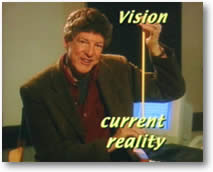
'I call the relationship between the vision and current reality structural tension. During the creative process, you have an eye on where you want to go, and you also have an eye on where you currently are.
There will always be structural tension in the beginning of the creative process, for there will always be a discrepancy between what you want and what you have. Why? Because creators bring into being creations that do not yet exist. Structural tension is a fundamental principle in the creative process. In fact, part of your job as a creator is to form this tension.'
From 'Creating' by Robert Fritz
http://www.robertfritz.com/index.php?content=principles
Monday, March 1, 2010
Ghost in the Machine
Rene Descartes, a seventeenth-century French scientist and philosopher proposed the concept of dualism in view of the mind and the brain. Descartes viewed the brain as an organic substance whereas the mind was a mysterious cloud of consciousness. The theory was later dubbed as the Ghost in the Machine. The analogy came from the idea that the carbon based machine we call the human body is operated by a nebulous mind that is not rooted in the material world. The question then lies on how do thoughts, ideas, feelings and emotions materialize into reality and impact our life on a daily basis.
The average person has approximately 50,000 to 70,000 thoughts a day which means that a thought is generated every second of our waking life. The world we create begins in a place where we seldom venture due to many reasons. Fear, anxiety, ignorance and apathy could all substantiate our belief in why we should not tread in the domain of the mind. The thoughts that spring up every second most often try to convince our body into believing that the rule of life revolves around fight or flight. We have conditioned our nervous system to react to the external environment instead of creating our reality from within.
The bio-skeletal body seeks to satisfy its needs through addiction that is rooted in thought. Present day situations around the world clearly indicate that the majority of the thoughts that past through the mind are manifested into a reality that begins in negativity. A higher consciousness seeks to address what the lower reptilian brain does not. Though the brain is equipped with a driver, we fail to realize that its on auto pilot heading down into a chasm that we choose to ignore.
Movement throughout history has its beginning through collective consciousness. When the majority of the populace believes that a brighter future lies in their hands, it sets the stage for change. Change begins with individuals who bypass the fear generated by the lower brain and seek to enlighten the mind with possibilities. E=mc2, Mona Lisa, iMac, Space Shuttle Discovery all began with a thought that was harvested from the courage of great men and women. Unlimited great thoughts are waiting to be materialized into our world, one that is seeking an answer to our survival.
Knowing that our thoughts create our reality, how do we rein in our mind when its bucking like a wild horse and nurture it to choose a path of unlimited potential. A simple 10-step solution will not suffice in this ongoing battle. A concentrated effort must be utilized. A process that can bring us nearer to our optimum latent capabilities resides in ideas that will only become visible through our genuine desire for positive change.
Read the Manual
The deluge of information in this century more often confuses and desensitizes the recipient. Over stimulation has created a stressed out society ready to engage in battle on any front. The office, home, countries, earth, all have become battlefields for this. The seeker of truth has to sieve through mountains of information only to be faced with an onslaught of theories, concepts and coping strategies.
If we believe that we have a say in our life, there should then be a manual that gives us an understanding of how the outer world affects our inner reality. The manual is stylized and personalized by the owner himself. He decides on how his life should be. However beyond the uniqueness of the individual lies a constant desire to reach that place of understanding, the owner needs to be aware of how he operates in this world.
Awareness begins by listening to your thoughts and making the realization that they have an affect on your life. Take note of the thoughts that go through you every day. Separate the thoughts that have potential for your growth and those that might cause your downfall. Understanding your own unique manual and mode of operation through your thoughts will steer you towards the life you desire.
Being in the Moment
Life is constantly created in the present. However the past and future intertwine into a mangle that we constantly relive. Getting out from its clutches begins by being still. The eye of a hurricane is where stillness resides compared to the chaos that surrounds it. Take time to be still and let the chaos surrounding you subside. A hurricane loses its energy as it goes further inland and like life, grounding oneself increases your tenacity to survive the chaos that surrounds you. Take time everyday to meditate or just reconnect with yourself through observing your breath. Every breath we take is an opportunity to create a life we desire and reminds oneself of the beauty of life.
Focus on Infinite Growth
Like the bamboo whose beginning might be slow and arduous, once it reaches its potential it climbs toward the heavens in leaps and bounds. Research has shown that the mind and the brain have infinite potential and capabilities. We have yet to utilize even a fraction of what it holds. With our endless stream of thoughts, we are capable of attaching and rooting it down to be manifested into reality. Begin your day by affirming your worthy thoughts and declare your intention to grow as a person. Chart your own growth in all areas of your life and address the areas that are stagnating.
Decide on Life
The negative mindset that we unknowingly cultivate siphons away the very life we are trying to build. The choices we make in life have an affect on our future generations and not taking responsibility for our actions will accumulate in suffering in the future. Question yourself; are you are existing or living in this world right now. What constitutes a life and what does that life resemble? We seldom ignore the fact that we are not making full use of our gifts to create change but succumb to the dreary idea that we have no choice in life. Make a choice today to Live.
Expect a Struggle
Going back to an undesirable routine and self-destructive habits is always a way out from pain. The comfort of knowing that there is a safe place that we can go back to prevents us from reaching the other side of the bridge. When the moment seems unbearable, we source for alternatives to take the pain away, even though the methods we use inflict more pain than we realize. The struggle with the Gremlins in our mind will always be there and expect that it will be a continuous battle. The negative self talk at times seems more favorable without taking a step back to reflect on the consequences of the action.
The journey towards understanding the mind and its power begins with the desire to change and evolve. It’s a long road, filled with wonders and excitement and at times, pain and suffering. No matter what it brings, it’s a life lesson. Take control of the Ghost in the Machine.
Saturday, February 20, 2010
Culture, Believes, Vision, Stories - Some thoughts and theories
'A shared vision is not an idea...it is rather, a force in people's hearts...at its simplest level, a shared vision is the answer to the question 'What do we want to create?' Peter Senge
'Too many young people are being taught to give up their dreams before they have any experience attempting to pursue them'. Robert Fritz 'The Path of Least Resistance'
'It is not so much about to see what no one has seen before but to think what nobody has yet thought about that which everybody sees.' Schopenhauer
'We can no longer stand at the end of something we visualized in detail and plan backwards from that future. Instead we must stand at the beginning, clear in our mind, with a willingness to be involved in discovery... it asks that we participate rather than plan.' Margaret Wheatley and Kellner -Rogers.
'Positive images of the future are a powerful and magnetic force... They draw us on and energize us, give us courage and will to take on important initiatives. Negative images of the future also have a magnetism. They pull the spirit downward in the path of despair..' William James
'A belief is not a belief until you can visualize it, unless you can create a picture of it in your minds eye, especially if you have no doubts that reality can be - or is - possible.' Hedley Beare Aust Educationalist
'There are two mistakes one can make along the road to truth - not going all the way, and not starting.' Buddha
'You see things and say 'Why'? But I see things and say 'Why not?' G.B Shaw
No problem can be solved by the same consciousness that created it. We need to see the world anew.' Albert Einstein
'If we always do what we've always done, we will get what we've always got.' Adam Urbanski
'Anecdotes, personal stories, reminiscences, like biblical parables, are the medium through which faith is restored. Stories are a form of poetry, and give us a saving image to personally relate to.' Peter Block Business Philosopher
"There are many definitions of organization culture. We view culture from the ideational perspective (Martin, 2000), and thus define it as the shared beliefs and values of members of an organization that provide meaning to and influence daily work life. Similar to Louis (1985) and Schein, (1992), we understand these beliefs and values affect work behavior in tacit and nuanced ways. These shared beliefs and values are expressed in organizational life through various more visible manifestations including business strategies, performance targets and metrics, management practices, formal and informal rules that govern behavior, traditions, stories and other symbols. While these different cultural expressions are based on the underlying beliefs and values (Schein, 1992), once established they serve to confirm and reinforce those beliefs and values. What results is forceful reciprocal chain of influence that resists disruption and change. We also do not view culture as a monolithic construct where all beliefs and values are shared strongly or entirely across the organization. Instead, we acknowledge that most large organizations are comprised of diverse sub-cultures. Yet we also believe that these sub-cultures share fundamentally similar ways of thinking about things and doing things that distinguish one organization culture from another." from Realigning Organization Culture for Optimal Performance: Six principles & eight practices
Organization Development Journal, Winter 2009 by Levin, Ira, Gottlieb, Jonathan Z
One of the strongest and widely recognised criticisms of theories that attempt to categorize or 'pigeonhole' organizational culture is that put forward by Linda Smircich. She uses the metaphor of a plant root to represent culture, describing that it drives organizations rather than vice versa. Organizations are the product of organizational culture, we are unaware of how it shapes behaviour and interaction (also recognised through Scheins (2002) underlying assumptions) and so how can we categorize it and define what it is? Organizational communication perspective on cultureThe organizational communication perspective on culture is divided into three areas:
language,
'Too many young people are being taught to give up their dreams before they have any experience attempting to pursue them'. Robert Fritz 'The Path of Least Resistance'
'It is not so much about to see what no one has seen before but to think what nobody has yet thought about that which everybody sees.' Schopenhauer
'We can no longer stand at the end of something we visualized in detail and plan backwards from that future. Instead we must stand at the beginning, clear in our mind, with a willingness to be involved in discovery... it asks that we participate rather than plan.' Margaret Wheatley and Kellner -Rogers.
'Positive images of the future are a powerful and magnetic force... They draw us on and energize us, give us courage and will to take on important initiatives. Negative images of the future also have a magnetism. They pull the spirit downward in the path of despair..' William James
'A belief is not a belief until you can visualize it, unless you can create a picture of it in your minds eye, especially if you have no doubts that reality can be - or is - possible.' Hedley Beare Aust Educationalist
'There are two mistakes one can make along the road to truth - not going all the way, and not starting.' Buddha
'You see things and say 'Why'? But I see things and say 'Why not?' G.B Shaw
No problem can be solved by the same consciousness that created it. We need to see the world anew.' Albert Einstein
'If we always do what we've always done, we will get what we've always got.' Adam Urbanski
'Anecdotes, personal stories, reminiscences, like biblical parables, are the medium through which faith is restored. Stories are a form of poetry, and give us a saving image to personally relate to.' Peter Block Business Philosopher
"There are many definitions of organization culture. We view culture from the ideational perspective (Martin, 2000), and thus define it as the shared beliefs and values of members of an organization that provide meaning to and influence daily work life. Similar to Louis (1985) and Schein, (1992), we understand these beliefs and values affect work behavior in tacit and nuanced ways. These shared beliefs and values are expressed in organizational life through various more visible manifestations including business strategies, performance targets and metrics, management practices, formal and informal rules that govern behavior, traditions, stories and other symbols. While these different cultural expressions are based on the underlying beliefs and values (Schein, 1992), once established they serve to confirm and reinforce those beliefs and values. What results is forceful reciprocal chain of influence that resists disruption and change. We also do not view culture as a monolithic construct where all beliefs and values are shared strongly or entirely across the organization. Instead, we acknowledge that most large organizations are comprised of diverse sub-cultures. Yet we also believe that these sub-cultures share fundamentally similar ways of thinking about things and doing things that distinguish one organization culture from another." from Realigning Organization Culture for Optimal Performance: Six principles & eight practices
Organization Development Journal, Winter 2009 by Levin, Ira, Gottlieb, Jonathan Z
From wiki
One of the strongest and widely recognised criticisms of theories that attempt to categorize or 'pigeonhole' organizational culture is that put forward by Linda Smircich. She uses the metaphor of a plant root to represent culture, describing that it drives organizations rather than vice versa. Organizations are the product of organizational culture, we are unaware of how it shapes behaviour and interaction (also recognised through Scheins (2002) underlying assumptions) and so how can we categorize it and define what it is? Organizational communication perspective on cultureThe organizational communication perspective on culture is divided into three areas:
- Traditionalism: Views culture through objective things such as stories, rituals, and symbols
- Interpretivism: Views culture through a network of shared meanings (organization members sharing subjective meanings)
- Critical-Interpretivism: Views culture through a network of shared meanings as well as the power struggles created by a similar network of competing meanings
There are many different types of communication that contribute in creating an organizational culture:
- Metaphors such as comparing an organization to a machine or a family reveal employees’ shared meanings of experiences at the organization.
- Stories can provide examples for employees of how to or not to act in certain situations.
- Rites and ceremonies combine stories, metaphors, and symbols into one. Several different kinds of rites that affect organizational culture:
Rites of passage: employees move into new roles
Rites of degradation: employees have power taken away from them
Rites of enhancement: public recognition for an employee’s accomplishments
Rites of renewal: improve existing social structures
Rites of conflict reduction: resolve arguments between certain members or groups
Rites of integration: reawaken feelings of membership in the organization
- Reflexive comments are explanations, justifications, and criticisms of our own actions. This includes:
Plans: comments about anticipated actions
Commentaries: comments about action in the present
Accounts: comments about an action or event that has already occurred. Such comments reveal interpretive meanings held by the speaker as well as the social rules they follow.
- Fantasy Themes are common creative interpretations of events that reflect beliefs, values, and goals of the organization. They lead to rhetorical visions, or views of the organization and its environment held by organization members.
http://en.wikipedia.org/wiki/Organizational_culture
Culture is represented in a group’s:
language,
decision making,
symbols,
stories and legends, and
daily work practices.
Subscribe to:
Posts (Atom)